Objective Property Value in Greece: What It Is & Why It Matters
The term objective property value (antikeimeniki aksia) is frequently encountered in the Greek real estate market, yet its precise function is often misunderstood by international and domestic buyers alike. In Greece, the objective value is of paramount importance—not because it reflects a property's actual market price, but because it serves as the statutory and fiscal baseline for calculating transaction closing costs and annual property taxes.
If you are planning to purchase a residential apartment or invest in commercial property in Greece, mastering the mechanics of objective values is an essential practical tool. It enables you to calculate property transfer taxes, notary fees, and annual ENFIA tax liabilities with absolute precision, protecting you from inaccurate budgeting during the acquisition process.
1. What is an Objective Property Value?
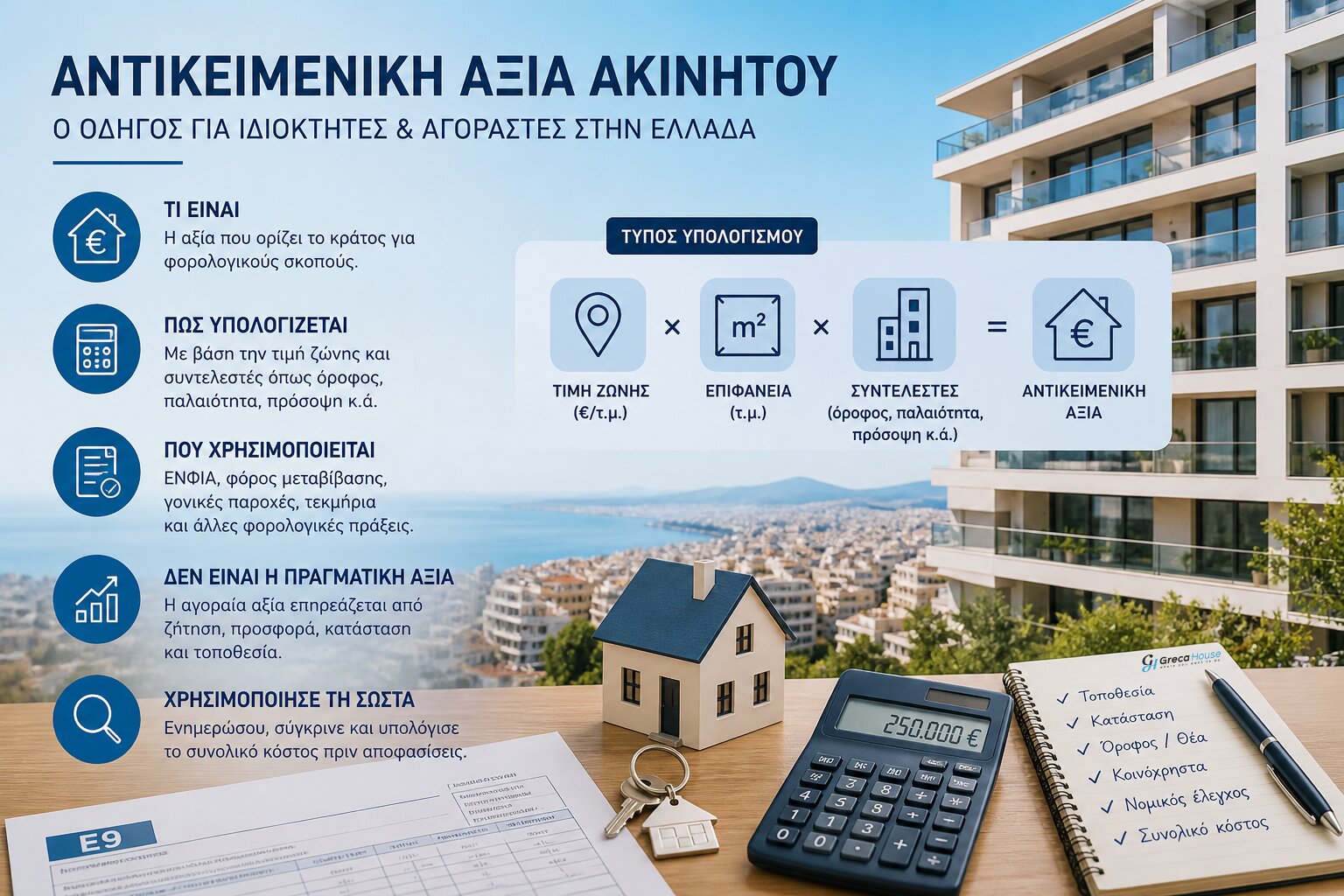
An objective value is the administrative valuation assigned to a real estate asset by the Greek Ministry of National Economy and Finance for tax and transactional purposes. Unlike commercial market value, it is not established through open-market negotiations or supply and demand dynamics; instead, it is derived from a standardized, nationwide algorithmic model applied across designated zones throughout Greece.
Consequently, two apartments located on the exact same street may share a nearly identical objective value, even if their actual market selling prices differ significantly due to interior condition, floor level, panoramic views, or luxury renovations. The objective value establishes a "mandatory fiscal floor," guaranteeing a predictable tax base for the Greek state.
2. How Objective Property Values are Calculated
The foundation of the calculation is the zone price (timi zonis), a fixed baseline rate per square meter established by the tax authorities for specific neighborhoods or municipal blocks. Several adjustment coefficients are then applied to the zone price to reflect the property's specific architectural features:
- Age coefficient: Reduces the assessed value as the building's age increases.
- Floor level coefficient: Increases the assessed value for higher-floor apartments.
- Commerciality and facade coefficient: Adjusts value based on whether the property faces a main thoroughfare or public square.
Additional multipliers evaluate ancillary spaces, assigning specific administrative values to underground parking spaces, storage units, and semi-outdoor areas.
3. Why Objective Value Matters in Property Transactions
In the Greek real estate framework, the objective value dictates nearly every financial transaction cost associated with property ownership. When executing a purchase contract, the Real Estate Transfer Tax (3.09%), notary fees, Land Registry filing fees, and legal representation costs are calculated on the objective value whenever it exceeds the agreed-upon contract purchase price.
This rule is frequently overlooked by first-time buyers: if you negotiate a bargain purchase price that sits below the official objective value, you will still be taxed based on the higher administrative valuation. Furthermore, annual property taxes (ENFIA), statutory living expense imputations (tekmiria), and inheritance or parental donation taxes are assessed strictly against objective values.
4. Objective Value vs. Commercial Market Value
A common error among investors is conflating objective tax values with actual commercial market values. Over recent years, rapid economic growth and surging demand in premier locations—such as central Athens, the Athens Riviera, the Northern Suburbs, and popular Aegean islands—have caused market prices to escalate significantly above current objective valuations.
Conversely, in regions experiencing lower demand or featuring unrenovated older building stock, objective values may occasionally exceed actual open-market selling prices. To navigate the market effectively, keep these distinctions in mind:
- Objective Value: The state-mandated fiscal valuation used exclusively for tax and fee assessments.
- Commercial Market Value: The real-time selling price determined freely by buyer demand and property availability.
- Investment Value: The financial worth assigned by an investor based on projected rental yields and capital appreciation potential.
5. How to Use Objective Values When Evaluating Properties
While objective values should never be used as the sole determinant of a property's worth, they serve as an invaluable benchmarking tool when evaluating an acquisition opportunity.
When analyzing a prospective property, compare the asking price against its official objective value. A substantial premium over the objective value should be justified by tangible assets, such as state-of-the-art energy upgrades, high-end architectural renovations, uninterrupted sea views, or prime commercial positioning. If such attributes are absent, the property may be overpriced.
6. Future Trends: Digital Convergence with Market Prices
The strategic objective of the Greek Ministry of Finance is to achieve complete convergence between objective tax valuations and actual commercial market prices. Through the rollout of the Property Ownership and Management Registry (MIDA) and the interactive valuemaps.gov.gr platform, tax authorities now monitor real-time transaction prices and rental data across the country.
In the near future, objective values will transition to an automated, dynamic adjustment system, eliminating historical discrepancies. For prospective buyers, working with knowledgeable real estate professionals ensures you accurately project future tax liabilities and secure a high-performing investment.