How to Spot an Overpriced Property in Greece: Key Signs & Buyer Tips
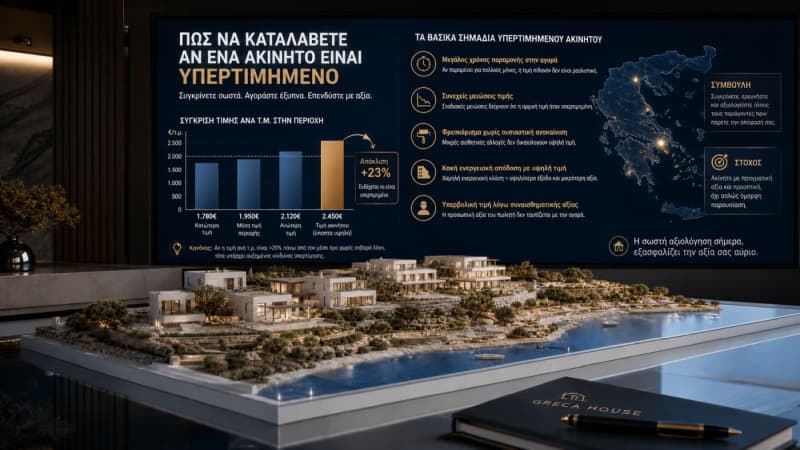
In the Greek real estate market, a common mistake among prospective buyers is failing to distinguish between an initial asking price and fair commercial value. While a residence may feature attractive presentation, desirable neighborhood aesthetics, or engaging marketing, these attributes do not guarantee that its asking price reflects legitimate market reality.
High demand across Greece over recent years has elevated seller expectations. While many properties are offered at fair, defensible valuations, the market also contains a notable percentage of overpriced listings. The ability to identify an overpriced property early in your search is essential for safeguarding your capital and securing superior long-term investment performance.
Defining an Overpriced Property
A property is not overpriced simply because it carries a high price tag or falls within the luxury segment. A property is overpriced when its asking price significantly exceeds the realistic market value justified by its structural characteristics, location, energy efficiency, and prevailing local market conditions.
The core issue lies in the gap between a seller's subjective expectations and the objective valuation derived from closed transactions of comparable properties. When a property owner sets an asking price based on personal financial needs, emotional attachment, or outdated market advice, the listing becomes uncompetitive and stagnates at an inflated valuation.
Conducting Precise Comparative Market Analysis
Analyzing price per square meter is the primary tool for verifying listing accuracy, provided the analysis relies on a strict apples-to-apples comparison.
To obtain a realistic picture of a micro-market, compare residences that share core architectural and structural parameters:
- Geographic Consistency: Even within the same neighborhood, differences in street elevation, views, traffic noise, and proximity to green spaces can meaningfully impact property values.
- Building Age and Condition: Never compare a unrenovated 30-year-old apartment with a newly constructed or completely reconstructed residence.
- Floor Level and Amenities: Ground-floor and lower-level apartments command lower per-square-meter valuations than upper-floor apartments or penthouses equipped with panoramic views and dedicated parking spaces.
If the prevailing average transaction price for a specific apartment category in a neighborhood is €2,200 per square meter, and a listing demands €2,800 per square meter without offering exceptional, rare amenities (such as a private garden, swimming pool, or Class A+ energy autonomy), that deviation is a clear indication of overpricing.
5 Unmistakable Signs of an Overpriced Property
Identifying an inflated valuation does not require a formal engineering degree. By monitoring listing behavior and examining property details, you can readily spot the five primary warning signs:
- Extended Days on Market: In today's active Greek real estate environment, correctly priced residential properties attract immediate interest and typically secure buyers within a few months. If a property remains listed across portals for 6, 9, or 12 months without selling, its price is almost certainly the primary obstacle.
- Successive Price Reductions: A listing history showing repeated, incremental price drops indicates that the initial valuation was detached from market reality and that the seller is slowly adjusting to actual buyer demand.
- Cosmetic Updates Priced as Complete Builds: Some sellers execute inexpensive cosmetic facelifts—such as applying fresh paint, installing laminate flooring overlays, and replacing kitchen cabinet doors—and subsequently raise their asking price by tens of thousands of euros, attempting to price the property alongside fully reconstructed or new-build homes.
- Low Energy Rating at Top-Tier Pricing: Energy performance is a primary cost factor in modern Greek real estate. An apartment with an Energy Efficiency Class of D, E, or Z that is offered at premium pricing is overpriced, as the acquiring buyer will face immediate, substantial capital expenditures for thermal insulation, heating systems, and double-glazed window replacements.
- Emotional Seller Pricing: When an owner incorporates sentimental value or the historical cost of personalized, outdated custom features into the asking price, the valuation loses connection with commercial reality.

The Role of Renovation in Property Valuation
Renovation is the most common justification cited for an elevated asking price. For an investor, however, the depth and engineering quality of those upgrades are what matter.
A comprehensive renovation that adds genuine structural equity includes:
- Complete replacement of plumbing networks, electrical wiring, and main distribution panels.
- Installation of modern, high-efficiency climate control systems (such as heat pumps or independent natural gas boilers).
- Fitting of certified, thermally broken aluminum window frames with double or triple energy glass.
- Application of certified exterior thermal facade insulation and professional roof waterproofing.
If the price premium applied to a renovated residence exceeds the actual engineering and material costs of the works performed, the buyer is being asked to pay an unjustified profit margin to the seller.
Negotiation Strategy and Knowing When to Walk Away
Recognizing that a property is overpriced does not automatically mean you must abandon the opportunity—especially if it meets your exact location and layout criteria. Instead, this insight provides leverage for an objective, data-backed negotiation.
How to Negotiate Effectively
Successful real estate negotiation relies on verified data rather than aggressive counteroffers. Present the seller or their agent with documented closed sale records of comparable properties in the immediate vicinity, accompanied by a detailed engineering cost estimate for necessary repairs and energy upgrades. When your counteroffer is supported by objective market and technical realities, sellers are significantly more likely to make rational price adjustments.
When to Walk Away
If a seller remains inflexible and committed to an unrealistic valuation, the most prudent strategic decision is to walk away immediately. Emotional attachment to an overpriced property is one of the most reliable ways to erode capital equity. The Greek property market is diverse, and patience consistently rewards buyers who wait for fairly valued opportunities.
Conclusion: Investing with Clarity and Protection
Acquiring property in Greece is a significant financial commitment that demands objective analysis and disciplined decision-making. Learning to differentiate between fairly priced real estate and inflated listings ensures that your capital is invested in genuine, sustainable equity.
At Greca House, we protect our clients' investments through rigorous property vetting, verified market data analysis, and expert valuation standards. Explore our curated portfolio of properties for sale in Greece or contact our advisory team to secure expert professional representation during your property search and negotiations.