How to Buy the Right Commercial Property for Your Business
Acquiring commercial real estate is a milestone decision for any enterprise or investor. The physical environment where business operations take place directly impacts daily workflow, customer foot traffic, brand perception, and overall operating costs. For this reason, searching for commercial properties and retail spaces for sale requires systematic evaluation and a clear corporate strategy.
Unlike residential property acquisitions, where personal comfort and aesthetics are primary drivers, selecting commercial premises is intrinsically linked to measurable business objectives. Geographical location, accessibility, neighborhood commercial vibrancy, and the property's potential for future upgrading dictate the viability and financial success of the investment.
Whether establishing corporate headquarters or building a reliable income-generating portfolio, making an informed choice among available commercial properties can unlock substantial growth potential and secure long-term capital appreciation.
Why Choosing the Right Commercial Space is Critical
A commercial property serves as the operational hub of an enterprise. It is where staff collaborate, clients are hosted, and corporate identity is projected to the public. Consequently, an effective location and well-designed building infrastructure act as powerful multipliers of commercial success.
Internal layout and ergonomics govern productivity and smooth operational flow. A space tailored to professional needs simplifies logistics and reduces overhead costs, whether operating a retail flagship store, modern administrative offices, or a logistics distribution center.
Furthermore, location is paramount for brand visibility. A storefront on a high-traffic retail avenue or an office suite in an accessible business district provides immediate market recognition and facilitates seamless connectivity for partners and consumers.
Moreover, owning commercial real estate in a high-demand district represents a tangible asset that hedges against inflation and delivers consistent capital growth over the long term.
Define the Property's Primary Use
Before initiating your search, clearly define the intended primary use of the property. Different business sectors demand specific location characteristics, spatial layouts, and technical specifications. The core categories of commercial real estate include:
- Retail Use: Shops, dining establishments, and consumer service centers. For these properties, storefront visibility, street prominence, and heavy pedestrian traffic are essential advantages.
- Office Use: Spaces designed for corporate teams, professional practices, and technology startups. Proximity to public transportation, structured data cabling, efficient HVAC systems, and dedicated parking spaces dictate desirability.
- Hospitality and Tourism: Assets intended for hotels, boutique accommodations, or serviced apartments. Geographic positioning, proximity to landmarks, and local tourism dynamics are critical success factors.
- Logistics and Warehousing: Facilities supporting freight distribution, shipping, and e-commerce operations. Key requirements include direct access to major highway networks, high ceiling clearance, and efficient loading docks.
- Industrial and Craft Facilities: Production plants and manufacturing workshops. These properties must be situated within designated industrial zones and require robust electrical power infrastructure and reinforced industrial flooring.

The Greek real estate market offers a diverse array of commercial and industrial premises. Each building type caters to distinct business models, requiring evaluation criteria to align seamlessly with corporate strategic plans.
When reviewing commercial spaces for sale, focus on properties that fulfill current operational demands while accommodating future corporate expansion.
Retail Stores and High-Visibility Showrooms
Retail stores represent one of the most prominent categories of commercial real estate, accommodating activities such as:
- retail fashion and consumer goods,
- food and beverage concepts,
- customer service and banking centers.
Street commerciality, facade width, pedestrian accessibility, and branding visibility are the primary variables that drive retail performance and property valuation.
If you are searching for suitable premises for your company, explore our active listings of stores and business spaces within our curated commercial properties portfolio.
Office Spaces and Business Centers
Office spaces form the backbone of the urban service economy, catering to:
- freelancers, medical practitioners, and legal firms,
- consultancies and financial service providers,
- startups, tech enterprises, and corporate headquarters.
Building construction quality, energy efficiency rating, modern elevator access, parking availability, and proximity to metro stations determine an office's attractiveness to talent and visiting clients.
Hotels and Tourism Properties
Greece's thriving tourism industry offers exceptional real estate investment opportunities. Acquiring hotel units, resorts, or residential buildings suitable for conversion into boutique hotels attracts strong domestic and international institutional interest.
The return on a tourism investment depends heavily on regional destination popularity, the length of the tourism season, hospitality infrastructure standards, and operational excellence.
Warehouses and Logistics Centers

The rapid expansion of e-commerce and regional supply chains has dramatically increased demand for modern distribution facilities. Warehouses serve:
- logistics, freight, and distribution operators,
- e-commerce fulfillment centers and wholesale merchants,
- manufacturing firms requiring organized supply hubs.
Essential features of a modern logistics facility include direct highway connectivity, high vertical clearance, heavy-duty industrial flooring, and multiple loading ramps.
Craft and Light Manufacturing Spaces
Craft facilities are engineered for light manufacturing, assembly workshops, and technical servicing firms. They provide a practical combination of workspace and storage capacity.
Locating these enterprises within properly zoned areas ensures straightforward licensing and full regulatory compliance for daily operations.
Industrial Properties
Industrial properties are designed for heavy manufacturing, processing plants, and large-scale industrial production. They require extensive land plots, high voltage industrial power supply, and specialized waste management infrastructure.
These assets are typically located within organized Industrial Areas or Industrial Parks, featuring roadway networks engineered for heavy articulated transport.
Standalone Commercial Buildings
Standalone commercial buildings represent prestigious acquisitions for major corporations seeking to consolidate administrative, executive, and operational divisions under a single corporate roof.
Simultaneously, they serve as prime institutional investment vehicles, capable of being multi-let to diverse corporate tenants to generate risk-diversified, recurring revenue streams.
Exhibition Halls and Conference Venues
Multi-purpose halls and specialized commercial venues are structured to host events such as:
- corporate conferences and trade exhibitions,
- professional training seminars and educational academies,
- cultural gatherings and corporate presentations.
Key architectural requirements include open-plan layouts without obstructive internal columns, advanced HVAC ventilation, fire safety compliance, and integrated acoustics.
Essential Checks Before Buying Commercial Property
Acquiring commercial real estate demands rigorous legal and technical due diligence. Prior to contract execution, buyers must conduct thorough verifications at the Land Registry and Urban Planning Office to confirm valid building permits, absence of unauthorized zoning violations, and full alignment with approved architectural plans.
Special attention must be given to municipal land use regulations and co-ownership building regulations (in multi-tenant structures) to guarantee that an operating license can be lawfully issued for the intended business activity.
Location and Commercial Dynamics
Location remains the fundamental determinant of real estate value. A commercial space in a strategic setting guarantees brand prestige, consistent foot traffic, and effortless commuting for employees and executives.
Analyzing neighborhood trajectory, competitive presence, local safety, and upcoming municipal infrastructure projects (such as metro expansion lines) determines the property's long-term commercial performance and capital appreciation.
Buying Commercial Property as an Investment
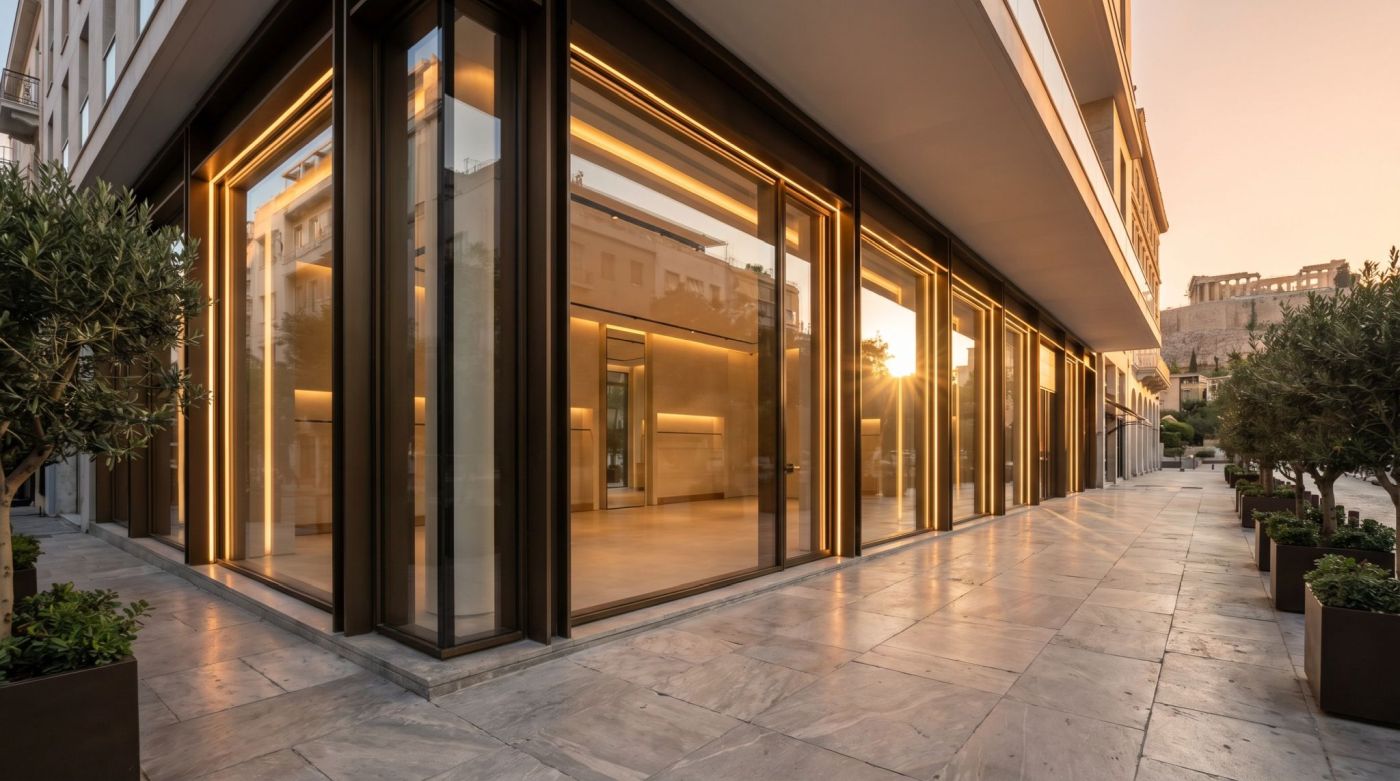
Commercial real estate is a preferred asset class for investors seeking stable passive income and long-term capital growth. Compared to residential properties, commercial spaces offer compelling structural advantages that optimize return on investment.
Core benefits of commercial property investing include:
- Higher gross rental yields compared to the residential housing sector.
- Long-term commercial lease agreements that ensure cash flow stability and minimize vacancy risks.
- Lease structures where maintenance and operational expenses are frequently borne by the tenant, protecting the landlord's net yield.
Commercial Real Estate via Greca House
Greca House manages a comprehensive and vetted portfolio of commercial properties across Athens and throughout Greece, satisfying the demands of diverse business sectors and investment strategies.
Our advisory team delivers tailored consultancy, analyzes local market trends, and guides purchasers through every phase of negotiation, technical due diligence, and transaction closing.
Read also: Buying a Commercial Building - Why It Pay Off Long-Term