How Much Does an Apartment Renovation Cost in Athens? 2026 Budget Guide
Renovating an apartment in Athens is a pivotal financial decision that can dramatically transform a property's market valuation, functional performance, and aesthetic appeal. Whether you are upgrading a residence for personal living, preparing an asset for immediate sale, or optimizing a rental investment, establishing a precise budget is the foundation of success.
In 2026, renovation costs in Athens are shaped by a complex interplay of variables: the age and structural integrity of the building, the condition of electrical and plumbing networks, material quality specifications, total floor area, neighborhood location, and the desired level of finish.
According to official statistical data from ELSTAT regarding the New Residential Building Construction Material Price Index, construction material costs maintain an upward trajectory. This economic reality underscores the need for strategic planning and disciplined budgeting in 2026, ensuring you understand from the outset which technical improvements deliver the strongest return on investment.
How Much Does Renovation Cost Per Square Meter in Athens in 2026?
There is no universal, one-size-fits-all price tag for apartment renovations. A cosmetic surface refresh differs fundamentally from a full-scale structural remodeling that involves demolishing internal walls, rewiring electrical grids, replacing all plumbing pipes, installing energy-efficient window frames, and designing custom kitchens and bathrooms.
However, based on current Athenian market realities, renovation costs can be categorized into three realistic per-square-meter tiers:
- Basic cosmetic renovation: approximately €350 – €500 per sq.m.
- Medium / quality renovation: approximately €550 – €800 per sq.m.
- Full high-end luxury renovation: approximately €850 – €1,200+ per sq.m.
These price ranges serve as baseline estimates and adjust according to property specifics. For instance, a 1970s apartment in central Athens typically requires complete replacement of concealed MEP (mechanical, electrical, plumbing) infrastructure, whereas a property constructed in 2000 may only require functional updates and surface aesthetics.
Sample Renovation Budget for a 70 sq.m. Apartment
For a standard 70 sq.m. residential apartment in Athens, a realistic capital allocation breaks down across the following specification levels:
Basic Renovation (€24,500 – €35,000)
At this level, work focuses on visual refreshing and basic functional maintenance. Scope includes professional interior painting, floor restoration or installation of cost-effective laminate, minor electrical additions (such as new sockets and switches), and light updating of the bathroom and kitchen without altering spatial layouts or plumbing points.
This strategy is well-suited for properties with sound underlying technical infrastructure that require a clean, attractive presentation for rapid rental turnover or sale.
Medium Renovation (€38,500 – €56,000)
The medium renovation represents the most popular and balanced approach for Athenian property owners. It encompasses complete removal and installation of a modern custom kitchen, full bathroom reconstruction, high-quality flooring throughout, new interior doors, upgraded lighting schemes, and essential plumbing and electrical rewiring at critical utility junctions.
This tier achieves an excellent balance between capital expenditure and value creation, making the apartment highly competitive among discerning buyers and quality long-term tenants.
Full High-End Renovation (€59,500 – €84,000+)
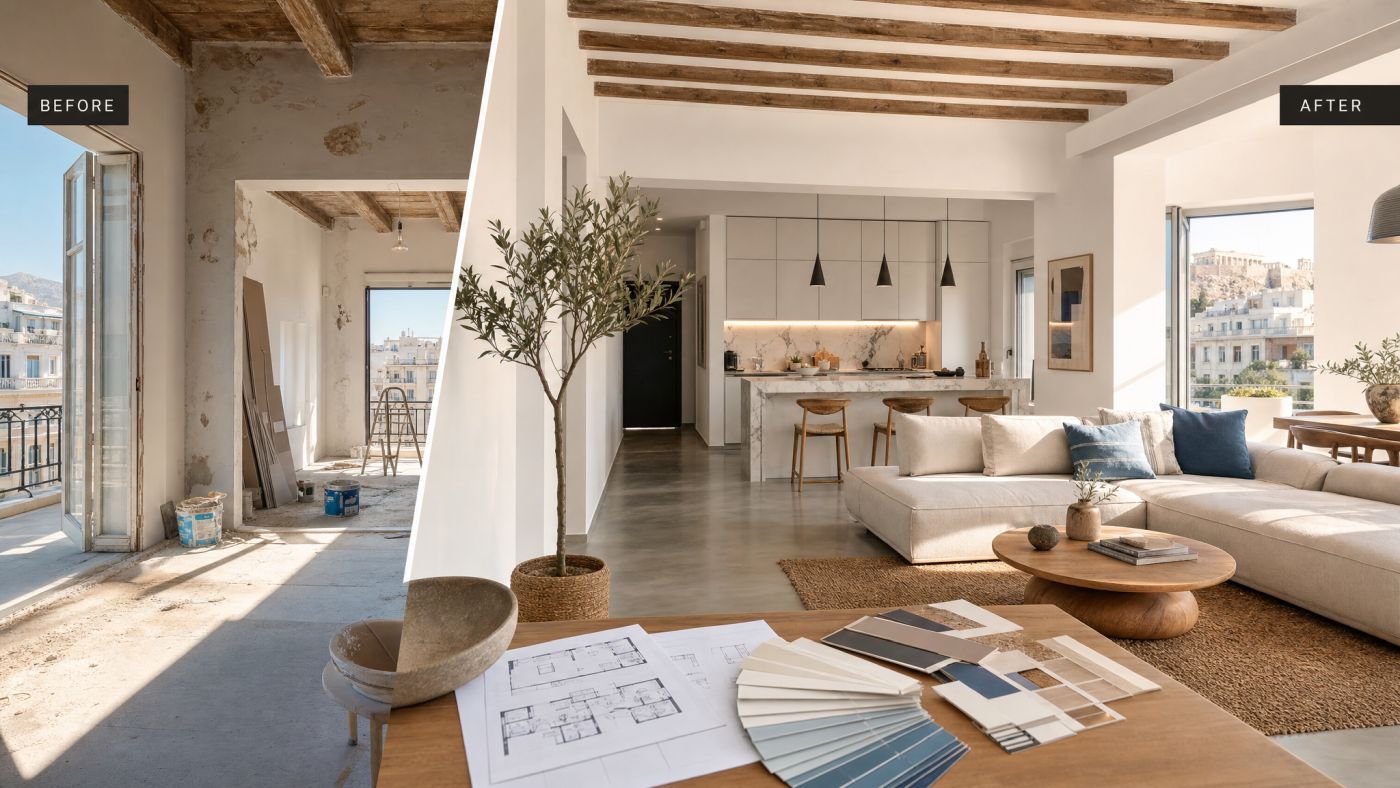
This comprehensive tier transforms older apartments into luxury, turnkey residences. The scope involves complete demolition and re-installation of electrical and plumbing networks from scratch, premium aluminum thermal-break window frames with double or triple glazing, external thermal insulation, bespoke kitchen and bathroom joinery, custom built-in wardrobes, a reinforced security door, multi-split or heat pump HVAC systems, and architectural lighting design.
This executive approach is the optimal strategy when renovating assets located in prime Athenian neighborhoods where buyers demand uncompromising quality and modern living standards.
Which Construction Works Consume the Largest Budget Share?
During renovation planning, individual construction trades carry different financial weights. Allocating capital efficiently requires identifying the most cost-intensive interventions, which typically include:
- Complete bathroom reconstruction, requiring comprehensive demolition, waterproofing, plumbing, tiling, and sanitary ware.
- Custom kitchen design and manufacturing, involving bespoke joinery, hardware mechanisms, and durable worktops.
- Plumbing and drainage network replacement, providing essential long-term security against water damage.
- Electrical panel upgrades and full rewiring, ensuring safety and capacity for modern appliance loads.
- Energy-efficient window and balcony door frames, improving thermal comfort and sound insulation.
- High-quality flooring installation (such as engineered oak hardwood or large-format porcelain tiles).
- Thermal insulation and energy performance upgrades.
- Custom carpentry and bespoke architectural built-ins.
In practice, the kitchen and bathroom are the two spaces that dictate a buyer's perception of overall property quality. An outdated bathroom can degrade the appeal of an otherwise bright apartment, whereas an ergonomic kitchen and an immaculate modern bathroom act as powerful commercial drivers.
Renovating for Personal Living vs. Selling: Strategic Differences
The ultimate purpose of the property dictates the guiding philosophy and budget structure of the renovation. When upgrading a home for personal living, decisions are driven by individual lifestyle preferences, bespoke functionality, and personal aesthetic tastes, where emotional returns justify specialized expenditures.
Conversely, when renovating an asset specifically for resale, a disciplined, commercial methodology is required. Over-spending on ultra-luxury materials or highly idiosyncratic design choices rarely translates into a proportional increase in resale valuation. The objective is to create a bright, clean, functional, and neutral living space that allows prospective buyers to effortlessly envision their own lifestyle within the home.
Pre-sale renovation should never be excessive; it must be strategic, targeted, and commercially viable, generating value that exceeds construction expenditure. For owners planning a value-add resale, the ideal starting point is a professional valuation via Greca House's property valuation service, ensuring your proposed construction budget aligns perfectly with neighborhood market ceilings.
Which Upgrades Add the Most Commercial Value to a Property?
Certain interventions carry disproportionate weight during sales negotiations because they directly resolve major buyer concerns and ongoing maintenance risks. The home improvements with the highest return on investment (ROI) include:
- Full bathroom modernization and waterproofing.
- Ergonomic, open-concept kitchen redesigns.
- Energy-efficient aluminum window frames with double glazing.
- Comprehensive energy efficiency improvements.
- Certified electrical rewiring and modern plumbing networks.
- Optimization of natural light and architectural LED lighting.
- Neutral, sophisticated color palettes and clean interior aesthetics.
- Floor plan optimization (e.g., creating open-plan living areas).
In high-demand Athenian neighborhoods, such as Koukaki, Pagrati, Ambelokipi, Kolonaki, Chalandri, Marousi, and the Athens Riviera, a strategically renovated apartment commands immediate market attention and superior pricing. Explore our portfolio of properties and apartments for sale to see how high-aesthetic renovated homes are positioned in the Greek marketplace.
Do You Need a Building Permit to Renovate an Apartment?
In Greece, construction activities are governed by specific regulatory frameworks. Simple maintenance tasks, such as interior painting and surface flooring replacement without structural load alterations, do not require a formal permit. However, interventions that modify internal room layouts, exterior facades, window openings, or mechanical installations must comply strictly with planning laws.
Many common renovation tasks require an Approval of Small-Scale Building Works (Έγκριση Εργασιών Δόμησης Μικρής Κλίμακας). This administrative approval is submitted electronically by a licensed civil engineer via the state digital portal. For more extensive construction projects involving structural changes, permits are managed through the official e-Adeies platform on gov.gr.
Consulting a qualified engineer prior to commencing demolition or construction is essential to prevent urban planning violations, substantial fines, project delays, and legal complications during future property conveyancing.
Energy Upgrades and the Energy Performance Certificate (PEA)
In the 2026 real estate landscape, a property's energy efficiency rating is a primary driver of market demand. Today's buyers and tenants actively evaluate projected monthly utility costs for heating, cooling, and electricity when comparing homes.
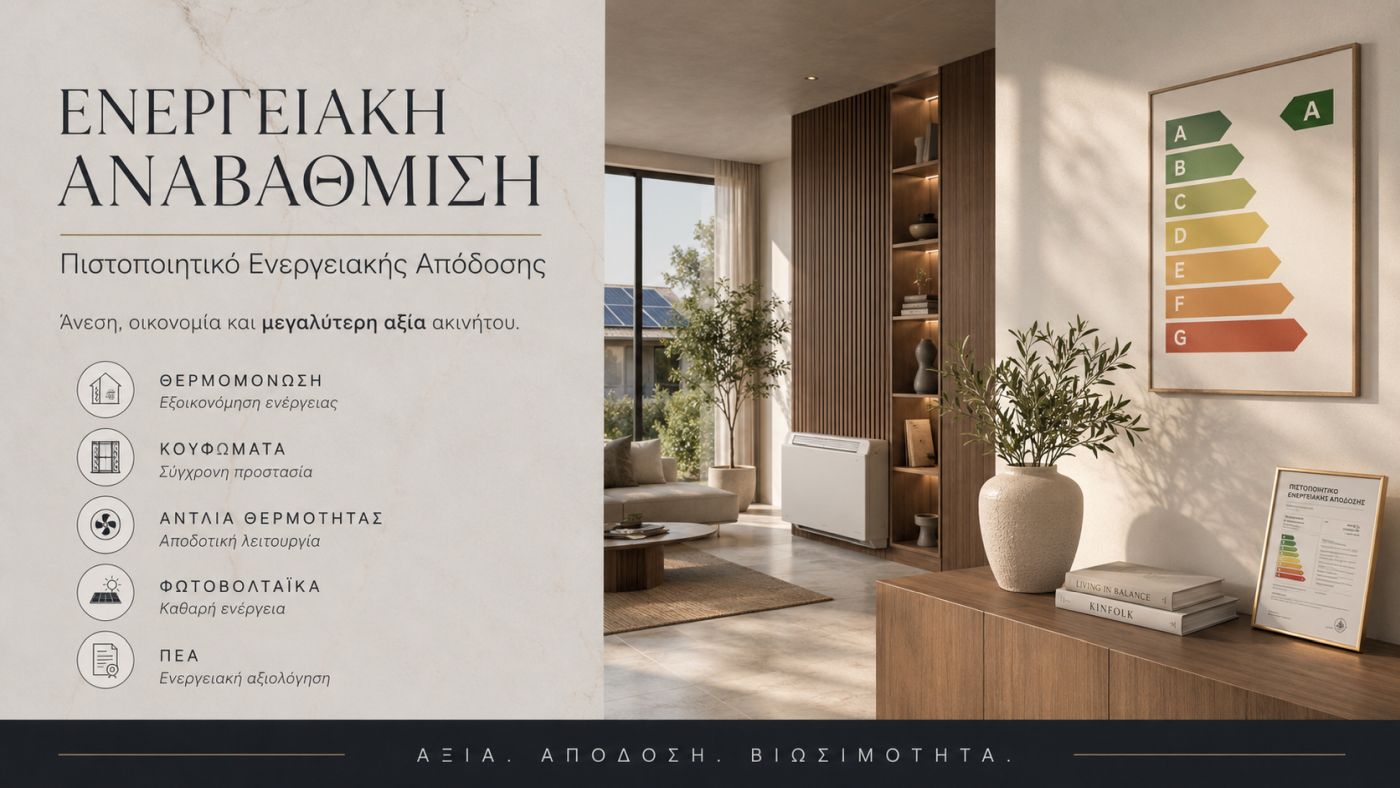
A comprehensive energy upgrade typically incorporates thermal-break aluminum window frames, external thermal facade insulation, high-efficiency heat pumps or autonomous gas boilers, solar water heaters, and smart climate control automation. An official Energy Performance Certificate (PEA) documents this superior efficiency. Detailed information on building energy performance is available on gov.gr, as well as on the official website of the Ministry of Environment and Energy regarding KENAK regulations.
A property achieving a superior energy class does not merely lower operating utility bills; it enjoys significantly faster commercial liquidity and commands a noticeable price premium upon resale or lease.
How to Organize Your Renovation Budget Effectively
The cornerstone of a successful construction project is meticulous budgeting. The most common error property owners make is commencing demolition without a detailed itemized specification and binding written quotes from contractors.
A professionally structured budget must explicitly account for:
- Labor costs for specialized construction crews and tradesmen.
- Precise material costs for structural, plumbing, electrical, and finishing goods.
- Demolition, debris removal, and transportation expenses.
- Kitchen cabinetry, bathroom vanity units, and sanitary fixtures.
- Complete plumbing and electrical network installations.
- Window frames, interior doors, and floor coverings.
- Professional engineering fees for architectural design, permits, and site supervision.
- A dedicated contingency fund of 10% – 15% of total budget.
Maintaining a contingency fund is critical when renovating older Athenian apartment buildings, as concealed technical requirements, such as corroded plumbing risers, compromised floor screeds, or moisture ingress, frequently come to light only after initial demolition works begin.
When Is Pre-Sale Renovation Genuine Value-Add Strategy?
Renovating a property prior to listing is a sound strategic investment whenever the projected post-renovation value increase exceeds total capital expenditure. A complete gut renovation is not always mandatory; in many scenarios, a targeted, partial modernization yields the highest financial return.
For example, an apartment featuring an excellent floor plan, abundant natural light, and a prime neighborhood location can achieve a remarkable valuation lift through professional painting, timber floor refinishing, modern lighting fixtures, and staging. Conversely, in unmodernized properties with obsolete MEP networks, a comprehensive renovation is essential to make the property competitive in the marketplace.
For deeper insight into structuring property improvements for maximum financial yield, consult our expert guide on maximizing property value through strategic planning.
The Role of Greca House Before and After Renovation
At Greca House, our daily market interactions confirm that a well-executed renovation can fundamentally reposition a real estate asset. However, successful property development does not rely on lavish spending; it relies on deploying the right specification level tailored to the specific demographic and price ceiling of the local neighborhood.
Before committing capital to construction, property owners require precise, data-driven answers to five critical questions:
- What is the true commercial market value of the property in its present condition?
- What is the realistic price ceiling for the property once fully renovated?
- Which specific architectural features and amenities are local buyers actively seeking?
- What specification level guarantees the highest net financial return on investment?
- Which renovation costs will fail to generate a premium during price negotiations?
Professional property valuation and strategic positioning are the vital pre-requisites that safeguard your capital and maximize net profits before construction even begins.
Final Thoughts
The cost of renovating an apartment in Athens in 2026 depends directly on the scope of construction interventions, building age, and the owner's strategic objectives. Costs start from approximately €350 per sq.m. for a surface refresh and can exceed €1,200 per sq.m. for a luxury, gut-rehabilitation project.
Ultimately, what matters most is not the total capital expenditure, but whether every euro invested generates compounding commercial value and liquidity for your property asset. When guided by market intelligence and disciplined execution, a renovation ceases to be an expense and becomes a high-yielding investment.
Are you planning to renovate, sell, or lease your property in Athens? Contact Greca House for an authoritative property valuation and tailored advisory services. To learn more about state funding opportunities, read our detailed guide on the Renovate 2026 subsidy program for older properties.